

Fire safety equipment checklist
A sample checklist for the routine check of fire safety equipment and provisions in a building. It covers access to and condition of extinguishers and hydrants, signage, clear escape routes and emergency lighting.
Safety and fire officers, facility managers and people running patrols use it. This is a routine check — it supplements, and does not replace, inspections carried out by authorised bodies.
- Category
- Fire safety
- Used for
- building, hall, commercial premises
- Number of points
- 13
- Suggested frequency
- monthly or as part of a patrol
Check points
Sample inspection questions with possible answers. This is a template — in Varilo you turn it into your own live checklist.
1.Are the extinguishers in their designated places?
YesNoN/A2.Is access to extinguishers and hydrants clear and unobstructed?
YesNoN/A3.Do the extinguishers have a valid inspection and undamaged seals?
YesNoN/A4.Do the extinguisher pressure gauges show a value in the working range?
YesNoN/A5.Are the hydrant cabinets complete (hose, nozzle) and undamaged?
YesNoN/A6.Is the fire equipment signage legible and visible?
YesNoN/A7.Are escape routes and exits clear?
YesNoN/A8.Do emergency doors open freely in the direction of escape?
YesNoN/A9.Are the escape signs complete and legible?
YesNoN/A10.Does the emergency lighting work?
YesNoN/A11.Are the manual call points and fire alarm panel accessible and free of fault signals?
YesNoN/A12.Are the fire safety instructions and evacuation plan available?
YesNoN/A13.Are materials stored in a way that does not increase the fire risk?
YesNoN/A
Move this checklist into Varilo
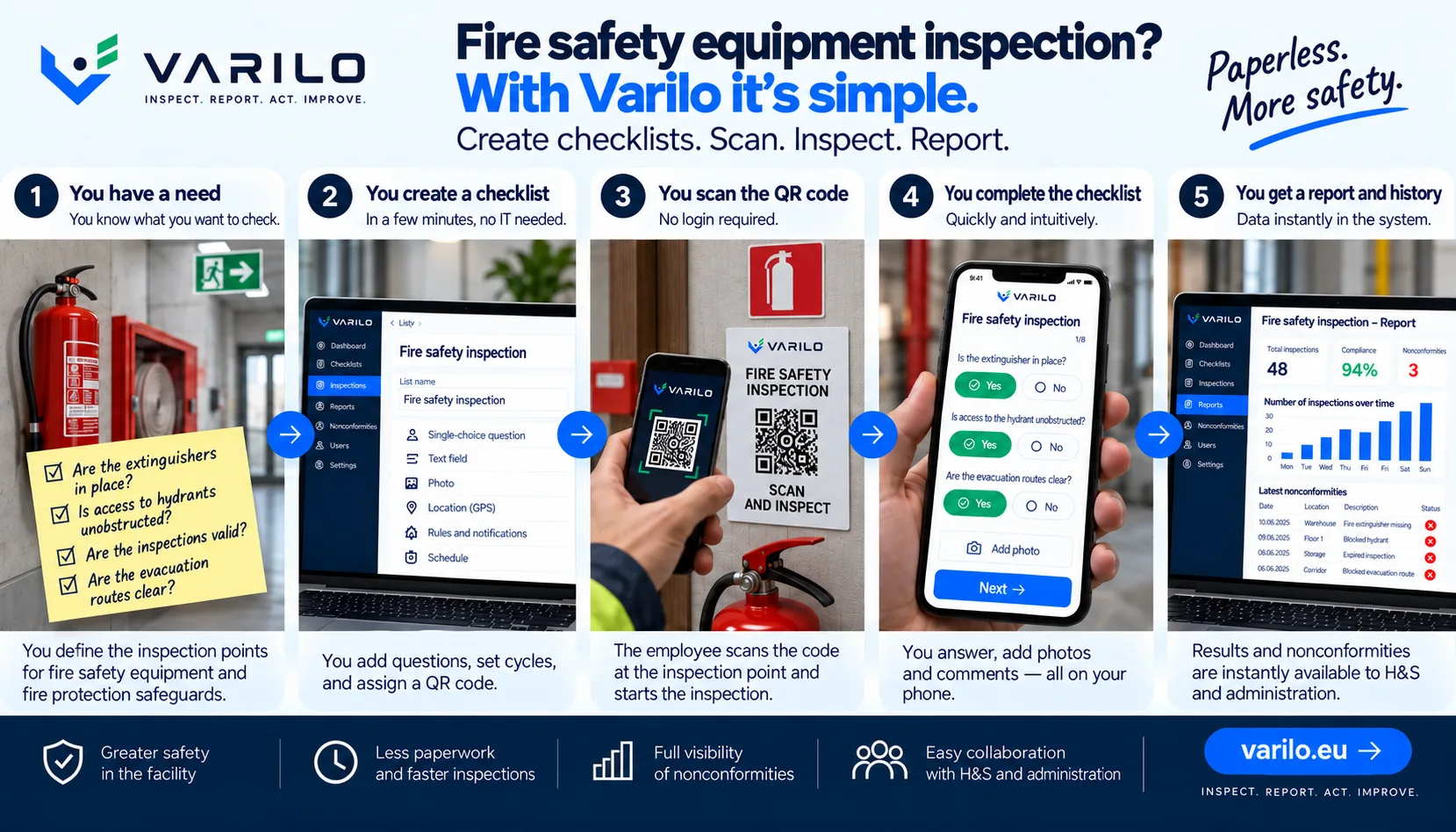
A paper checklist is only the beginning. In Varilo you can build your own version, assign it to a place, machine, vehicle or device and share it through a QR code or NFC tag.
The employee scans the code with a phone, completes the inspection and the results go straight into the system. You can track completed inspections, findings, reports and statistics without retyping paper forms.
Build the checklist
Assign QR or NFC
Run the inspection
Get the report
Routine check versus periodic inspection
Technical inspections of extinguishers and hydrants are carried out by authorised bodies at set intervals. This checklist is about something else: verifying that the equipment is in place, accessible and undamaged.
The two complement each other. The most common problem — a blocked extinguisher or exit — appears between inspections, and it is the routine check that catches it.
The most common findings
Recurring ones are: an extinguisher moved or blocked by a pallet, a blocked emergency door, illegible signage, failed emergency lighting and materials stored on an escape route.
Many of them arise during everyday work and disappear just as fast — which is why the frequency of checks matters more than their length.
Fire safety patrols with QR codes and NFC tags
Every point (extinguisher, hydrant, exit) can carry its own QR code or NFC tag. The employee scans the points in turn and the system records the time each one was reached.
The result is a single report for the whole patrol, showing which points were checked and where a finding was reported.
Use in your industry
See how companies in this industry run inspections in Varilo — from a single checklist to regular patrols.
Fire safety — Go to the industry pageRelated checklists
This checklist is a sample intended as support only. Adapt its scope to the type of site, equipment, process, risk assessment and the requirements and procedures that apply in your organisation.